



At Katzner Law Group, one of the most common estate planning questions we hear is: what is joint tenancy with right of survivorship, and how does it affect what happens to property after someone passes away? Joint tenancy with right of survivorship, often abbreviated as JTWROS, is a form of shared ownership that can play a powerful role in estate planning when used correctly. It allows property to pass automatically to a surviving owner without going through probate, which can save time, reduce costs, and provide peace of mind.
Understanding how JTWROS works is especially important for New York residents who own real estate, bank accounts, or investment assets with another person. While it offers meaningful benefits, it also carries risks that should be carefully considered with professional guidance.
What Is Joint Tenancy With Right of Survivorship (JTWROS)?
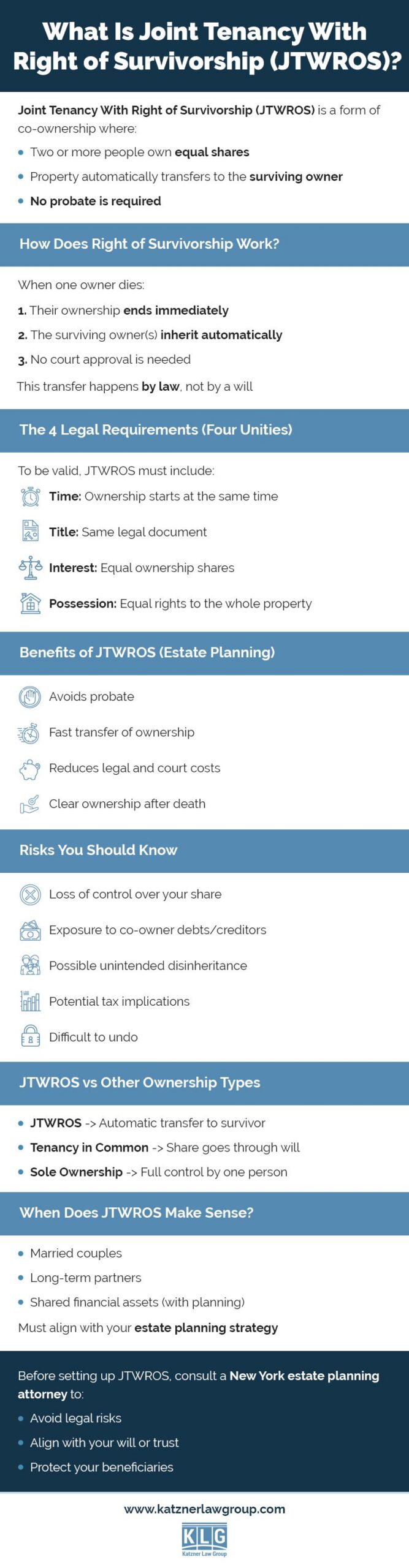
Joint tenancy with right of survivorship is a legal form of co-ownership where two or more people hold equal and undivided interests in the same asset. Each owner has the same rights to use and enjoy the entire property, not just a specific portion of it.
The defining feature of JTWROS is what happens when one owner dies. Instead of the deceased owner’s share passing through their will or the probate process, ownership automatically transfers to the surviving joint tenant or tenants. This transfer happens by operation of law, meaning no court approval is required for the ownership change to take effect.
In New York, joint tenancy with right of survivorship is commonly used for:
- Residential real estate
- Bank and brokerage accounts
- Investment property
- Certain types of personal property
Because of its automatic transfer feature, JTWROS is often used as an estate planning tool, but it is not appropriate for every situation.
How Does Right of Survivorship Work in Joint Tenancy?
The right of survivorship is the mechanism that allows property to pass directly to the surviving owner when one joint tenant dies. This process overrides instructions in a will. Even if the deceased owner named a different beneficiary in their estate plan, the jointly owned property will go to the surviving joint tenant.
Here is how the process generally works in New York:
- Two or more people take title to property as joint tenants with right of survivorship.
- Each joint tenant owns an equal share of the entire property.
- When one joint tenant dies, their ownership interest ends.
- The surviving joint tenant or tenants automatically become the full owner or owners of the property.
- The transfer is completed by filing appropriate documentation, such as a death certificate, with the relevant institution or county clerk.
According to guidance from the New York Unified Court System, assets that pass by operation of law, including property held in joint tenancy with right of survivorship, are generally not part of the probate estate. This distinction is critical when planning how and when assets will transfer after death.
Online Appointment Request Call Our OfficeContact an Asset Protection Attorney Near You
 855-528-9637
The Four Unities Required for Joint Tenancy
For joint tenancy with right of survivorship to be legally valid, New York law requires the presence of four unities. These legal principles help distinguish joint tenancy from other forms of co-ownership.
The four unities are:
- Unity of time: All joint tenants acquire their interest at the same time.
- Unity of title: All joint tenants acquire ownership through the same deed or document.
- Unity of interest: Each joint tenant holds an equal ownership share.
- Unity of possession: Each joint tenant has equal rights to possess and use the entire property.
If any of these unities are broken, the joint tenancy may be converted into a different form of ownership, such as tenancy in common, which does not include the right of survivorship.
Benefits of JTWROS in Estate Planning
Joint tenancy with right of survivorship can offer several advantages when incorporated thoughtfully into an estate plan.
Avoiding Probate
One of the most significant benefits of JTWROS is that property passes directly to the surviving owner without going through probate. Probate in New York can be time-consuming and costly, and avoiding it for certain assets can simplify the administration process for loved ones.
Speed and Simplicity
Because ownership transfers automatically, the surviving joint tenant often gains full control of the property quickly. This can be especially helpful when the asset is a primary residence or a bank account needed to cover ongoing expenses.
Cost Savings
By avoiding probate, families may save on court costs, filing fees, and legal expenses associated with administering an estate. This can preserve more of the asset’s value for the surviving owner.
Clear Transfer of Ownership
JTWROS provides clarity about who will own the property after death. There is little room for dispute when the ownership structure is properly established and documented.
Educational materials from Cornell Law School explain how survivorship ownership works and why it is treated differently from assets that pass through a will. This distinction underscores why JTWROS can be an effective planning tool in the right circumstances.
Risks and Limitations of Joint Tenancy With Right of Survivorship
While JTWROS offers benefits, it also comes with meaningful risks that should not be overlooked.
Loss of Control
Once property is placed into joint tenancy, each owner has equal rights. You cannot leave your share to someone else in a will, and you may need the other joint tenant’s cooperation to sell or refinance the property.
Exposure to Creditors
A joint tenant’s creditors may be able to place liens on jointly owned property. This means one owner’s financial troubles could affect the other owner’s interest.
Unintended Disinheritance
Because joint tenancy overrides a will, it can unintentionally disinherit other heirs, such as children from a prior marriage. This is a common issue when estate plans are not reviewed regularly.
Tax Considerations
Joint tenancy can create income tax or capital gains issues, particularly when real estate is involved. The tax consequences depend on how the property was acquired and who contributed to its purchase.
Difficulty Undoing the Arrangement
Ending a joint tenancy may require legal action or agreement from all parties. In some cases, disputes can arise if one joint tenant wants to sever the joint tenancy and the other does not.
In more complex scenarios, issues related to joint tenancy: five atypical situations may arise, especially when ownership structures involve blended families, unequal contributions, or conflicting estate plans that require careful legal evaluation.
Joint Tenancy vs Other Forms of Ownership
Understanding how JTWROS compares to other ownership structures can help clarify whether it is the right choice.
- Joint tenancy with right of survivorship: Property passes automatically to the surviving owner.
- Tenancy in common: Each owner has a separate share that can be left to heirs through a will.
- Sole ownership: One person owns the entire property and controls how it passes at death.
Each structure has different legal and estate planning consequences. Choosing the wrong one can create confusion, delays, or conflict after death.
When Joint Tenancy With Right of Survivorship Makes Sense
JTWROS may be appropriate in situations such as:
- Married couples owning a primary residence
- Long-term partners with shared financial goals
- Parents adding an adult child to a bank account for convenience (with careful planning!)
Even in these situations, professional advice is essential to ensure the arrangement aligns with broader estate planning goals.
How Katzner Law Group Helps Clients Use JTWROS Effectively
Estate planning is never one size fits all. At Katzner Law Group, we help clients evaluate whether joint tenancy with right of survivorship supports their long-term goals or whether alternative strategies may be more appropriate.
Our team assists with:
- Reviewing property deeds and account titles
- Explaining the legal and tax consequences of joint ownership
- Coordinating JTWROS with wills and trusts
- Updating estate plans as life circumstances change
By taking a comprehensive approach, we help clients avoid unintended consequences while maximizing the benefits of thoughtful planning.
Contact Katzner Law Group for Estate Planning Guidance
If you are considering joint tenancy with right of survivorship or want to understand how your property will pass after death, professional guidance can make all the difference. Katzner Law Group is an experienced estate planning firm dedicated to helping New York families protect their assets and plan with confidence.
To speak with our team, contact us or call 855-528-9637 to schedule a consultation. We invite you to contact Katzner Law Group and take the next step toward a clear and effective estate plan.
