



When families in New York begin the probate process, one of the most common questions we hear at Katzner Law Group is: can co-executors act independently, or do they have to agree on everything? The short answer, in most situations, is no. Co-executors are generally required to act together. Understanding how this shared authority works can help prevent delays, conflict, and costly mistakes during estate administration.
At Katzner Law Group, we work closely with executors, beneficiaries, and families to help them navigate probate smoothly and in compliance with New York law. If you are serving as a co-executor or are considering appointing more than one executor in your Last Will and Testament or Revocable Living Trust (it would be co-Trustees in a trust, but much of what follows applies to trusts as well), knowing the rules ahead of time can make all the difference.
What Is a Co-Executor of a Will?
A co-executor is one of two or more individuals appointed in a will to manage and settle an estate after someone passes away. Instead of naming a single executor, the testator chooses multiple people to share this responsibility. In New York, co-executors are treated as equals under the law, with the same powers, duties, and legal obligations.
The role of a co-executor typically includes:
- Filing the will with the Surrogate’s Court
- Notifying beneficiaries and heirs
- Collecting and safeguarding estate assets
- Paying valid debts and taxes
- Managing estate property during probate
- Distributing assets according to the will
While appointing co-executors can provide checks and balances, it can also add complexity. Each decision usually requires cooperation, communication, and mutual agreement.
Can Co-Executors Act Independently or Must They Act Together?
In most New York probate cases, co-executors cannot act independently. They are required to act jointly when administering the estate. This means they must agree on decisions, sign documents together, and manage estate matters in unison. Because co-executors share equal authority and responsibility, one co-executor acting alone without the consent of the other is typically not valid.
This joint authority exists to protect the estate and the beneficiaries. When decisions are made together, there is less risk of mismanagement, fraud, or unilateral actions that go against the terms of the will.
Examples of actions that usually require all co-executors to participate include:
- Opening and managing estate bank accounts
- Selling real estate or other major assets
- Filing probate petitions and court documents
- Approving distributions to beneficiaries
- Signing contracts on behalf of the estate
If one co-executor signs documents or makes decisions without the others, those actions may be challenged and reversed by the court.
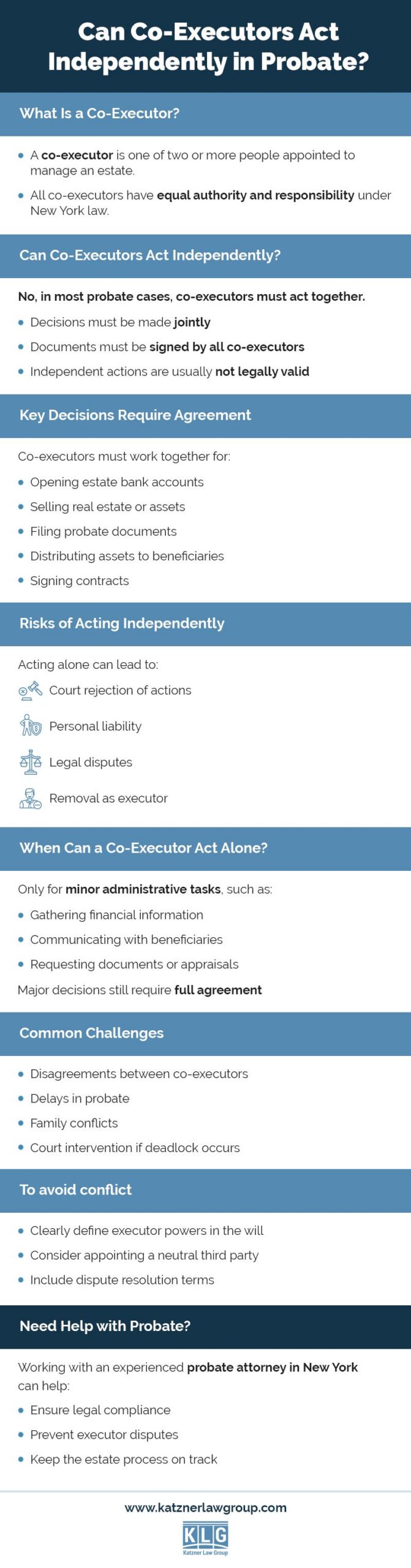
Why the Law Requires Co-Executors to Act Jointly
New York law views co-executors as fiduciaries who owe the highest duty of care to the estate and its beneficiaries. Requiring joint action helps ensure:
- Transparency in estate administration
- Accountability among executors
- Protection of beneficiary interests
- Compliance with the terms of the will
According to the New York Surrogate’s Court system, executors must follow strict rules when administering an estate, and failure to do so can result in personal liability. You can review general guidance on executor responsibilities through the New York Unified Court System, an official government resource that outlines probate procedures and fiduciary duties.
By requiring co-executors to work together, the court reduces the likelihood of unilateral decisions that could harm the estate.
Situations Where Limited Independent Action May Be Allowed
Although co-executors generally must act together, there are limited situations where minor or administrative tasks may be handled by one co-executor alone. These are usually actions that do not materially affect the estate or its beneficiaries.
Examples may include:
- Gathering preliminary financial information
- Communicating with beneficiaries or professionals
- Requesting account statements or appraisals
- Handling routine correspondence
Even in these situations, major decisions still require agreement. When in doubt, co-executors should consult an experienced estate planning or probate attorney before acting.
Challenges That Arise When Co-Executors Disagree
Disagreements between co-executors are one of the most common causes of probate delays. Because decisions must be made jointly, even minor disputes can bring estate administration to a standstill.
Common sources of conflict include:
- Differing interpretations of the will
- Disputes over selling or retaining property
- Conflicts about timing of distributions
- Personal or family tensions
- Unequal involvement or effort
When co-executors cannot agree, beneficiaries may suffer from delays, increased costs, and emotional stress. In extreme cases, disputes can escalate into litigation.
New York courts have the authority to intervene when co-executors are deadlocked. The court may issue instructions, require mediation, or even remove one or more executors if their conflict is harming the estate.
When One Co-Executor Is Unavailable or Unwilling to Act
Sometimes, a co-executor becomes unavailable or unwilling to fulfill their duties. This can happen due to illness, relocation, personal issues, or lack of interest in serving.
In these situations, options may include:
- Renunciation: A co-executor may formally decline the role by filing a renunciation with the court.
- Temporary authority: The court may allow the remaining co-executor to act under limited circumstances.
- Removal: If a co-executor refuses to cooperate or neglects their duties, the court may remove them.
- Court supervision: The Surrogate’s Court may issue orders to keep the estate moving forward.
The New York Estates, Powers and Trusts Law provides the legal framework for these situations, and guidance from a qualified attorney is often necessary to avoid procedural errors.
Another question families often ask during estate administration is how long do you have to file for probate after the death of a loved one. Understanding probate timelines can help executors avoid unnecessary delays and ensure the estate is handled in accordance with New York law.
Risks of Acting Independently as a Co-Executor
A co-executor who acts independently without proper authority takes on significant legal risk. Potential consequences include:
- Court rejection of unauthorized actions
- Personal financial liability
- Removal as executor
- Lawsuits from beneficiaries or other executors
Because co-executors share responsibility, mistakes can have serious consequences. This is why legal guidance is so important when questions or disagreements arise.
How Proper Planning Can Reduce Co-Executor Conflicts
Many co-executor issues can be avoided with thoughtful estate planning. When drafting a will, testators should consider whether appointing multiple executors is truly beneficial.
Helpful planning strategies include:
- Clearly outlining executor powers in the will
- Naming a neutral third party, such as a professional fiduciary
- Including dispute resolution provisions
- Appointing a successor executor
Educational resources from institutions such as Cornell Law School provide helpful overviews of executor duties and probate principles under New York law, helping families understand expectations before conflicts arise.
How Katzner Law Group Can Help Co-Executors Navigate Probate
Serving as a co-executor can feel overwhelming, especially when legal rules require cooperation at every step. At Katzner Law Group, we assist clients with:
- Understanding co-executor responsibilities
- Resolving disputes between executors
- Communicating with the Surrogate’s Court
- Ensuring compliance with New York probate law
- Keeping estate administration on track
Whether you are already involved in probate or planning ahead, working with an experienced estate planning firm can help you avoid costly mistakes.
Contact Katzner Law Group for Trusted Probate Guidance
If you are wondering whether co-executors can act independently, or you are facing challenges administering an estate, professional guidance can make the process far less stressful. Katzner Law Group is an experienced estate planning and probate firm dedicated to helping New York families protect their interests and move forward with confidence.
To speak with a member of our team, contact us through our website or call 855-528-9637. We invite you to schedule a consultation and learn how Katzner Law Group can support you through every stage of estate administration.

 (855) 528-9637