


Key Takeaways
- Community property states treat homes acquired during marriage as shared property.
- Common-law states grant ownership only to individuals listed on the property title.
- Property owned before marriage or inherited is generally considered separate property.
- Adding a spouse to a deed can convert separate property into community property.
- Mortgage responsibility may remain with one spouse even if both own the home.
Katzner Law Group helps married clients across New York who discover their name is missing from the deed to their own home. The question of what are my rights if my name is not on a deed but married comes up most often during a divorce, a separation, or when planning an estate, and the answer depends heavily on where you live and how the property was acquired. In New York, your rights can extend well beyond what the paperwork shows. Understanding how the law treats marital versus separate property, and how title alone does not settle ownership, is the first step toward protecting your interests.
Understanding Marital Property and Ownership Rights
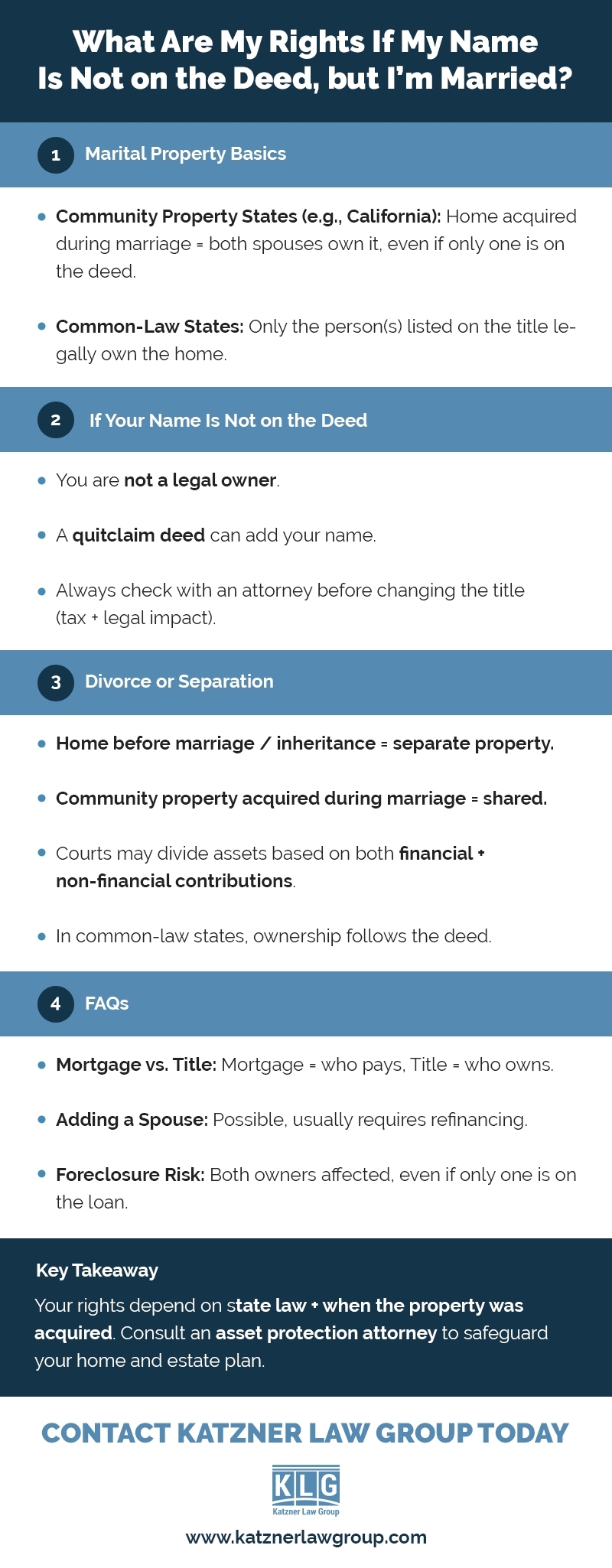
In community property states, such as California, if you acquired your home while you are married, the value of your home is equally shared between you and your spouse, whether your name is on the deed or not. This is the default situation and prevents one spouse from losing the home in the event of a divorce. This would not be fair if both spouses contributed money and maintenance to provide upkeep for the home.
If you want to give up your rights to your home, you would need to complete and file a quitclaim deed and a preliminary change in ownership form with your county recorder’s office.
If one of you owned the property before you got married or inherited it, the home would be considered separate property. If you put your spouse’s name on the deed, even if it is separate property, it would become community property.
If you live in a common-law state, you need to have your name on the home title to claim ownership of it. If your name is not on the title in a common-law state, you do not legally own the home or have ownership rights to it.
How New York’s Equitable Distribution Laws Affect Property Rights
If you have wondered what are my rights under New York law if my name is not on a deed but I am married, know that your rights remain substantial. New York follows an equitable distribution system, so property acquired during the marriage generally counts as marital property regardless of whose name appears on the title.
Under New York’s Domestic Relations Law § 236, marital property includes real estate, retirement accounts, and most assets either spouse acquires during the marriage, regardless of how title is held. A court may still divide a home in a divorce even though only one spouse signed the deed. Equitable distribution requires a fair, not necessarily equal, split based on each spouse’s contributions to the marriage.
Ownership on the Deed Does Not Always Determine Marital Rights
Many spouses assume the name on a deed settles the matter, but in New York, that assumption does not hold up in a divorce proceeding. Courts look past legal title and focus on when an asset was acquired, since timing, not paperwork, generally decides whether the law treats it as marital property. Even without your name on the title, you can still hold a financial interest in the home, and a court can award you a share of its value.
When Property May Be Considered Separate Instead of Marital Property
Not every asset acquired during the marriage qualifies as marital property. New York law recognizes separate property, which typically includes real estate owned before the marriage, inheritances, and gifts from someone other than the spouse, as well as property protected by a valid prenuptial or postnuptial agreement. This status does not always hold, however. Commingling separate funds with marital funds, or marital effort that increases the property’s value, can turn part of that property marital. This distinction matters most when someone asks what are my rights if my name is not on a deed but I am married, since separate property is not automatically protected once marital funds or effort become involved, and each case depends on its own facts.
What Happens If Your Name Isn’t on the Deed?
If your name is not on the deed, you are not the legal owner of the home. The easiest way to rectify this is to use a quitclaim deed to add your spouse to the title.
However, it is a good idea to discuss your options with your attorney before making any changes to your home deed. You will need to know whether state transfer taxes apply and whether the title change will impact your homestead exemption.
Rights During a Divorce or Separation
If your name is not on the deed, the outcome of a divorce or separation depends on when the home was acquired and whether you reside in a community property or a common law state.
If the home was owned by one spouse prior to the marriage or received as an inheritance or gift during the marriage, it belongs to that spouse alone. If the spouse wants to share ownership of the home, they will need to add the other spouse to the title. The only authority a court has over separate property is to set it aside to provide support for minor children.
If the home was acquired during the marriage in a community property state, the home belongs to both spouses, whether their name is on the title or not. The spouse whose name is on the deed is considered the legal owner. However, in a community property state, the court will look at the contributions of both spouses, both financial and non-financial, when dividing assets.
If the home was acquired before or during the marriage in a common-law state, the home belongs to the person or people whose name(s) are on the title.
If the home has a mortgage, the partner leaving the home will need to sign a quitclaim deed for the entire property. The spouse left with the mortgage will be responsible for paying it off. The spouse who quit claimed the home may still be entitled to equity in the house through a divorce lien.
If you owned significant property before marriage, talk with your attorney and your future spouse about signing a premarital property agreement. This document can specify who owns each property and how the property would be divided in the event of a divorce.
Another way to manage property in a community property state is to partition or exchange community property. Using this agreement, each spouse can own a fraction of the property. The shares do not have to be equal. During a divorce or separation, spouses can trade their interests in the marital property to divide the marital assets into separate property for each spouse.
Frequently Asked Questions
What happens if one spouse’s name is on the mortgage, but both names are on the title?
If only one spouse’s name is on the mortgage, then only that spouse is legally required to make the mortgage payments. If both spouse’s names are on the title, then they both own the house, even though only one is legally responsible for paying for it. To explore the reverse scenario, learn more about What Are My Rights If I’m on the Deed but Not the Mortgage?.
Can you add a spouse to the mortgage after marriage?
Yes, you can add a spouse’s name to the mortgage after marriage. However, doing so typically requires refinancing the loan.
Does your spouse’s name need to be on your deed?
Most people add their spouse’s name to the deed on their home to avoid the probate process if the spouse who legally owns the property dies before the surviving spouse. If you live in New York, a New York probate attorney can explain how titling decisions you make today affect what your family goes through in probate later.
What if one spouse defaults on the loan?
If only one spouse is responsible for paying the mortgage, but both have their name on the title, and they default on their mortgage payments, the house can be foreclosed. A foreclosure can impact both spouses, even the one who is not legally responsible for paying the mortgage, because they both own the home.
Understanding your rights during marriage or upon divorce, especially if your name is not on the deed, is essential. The legal right to property and ownership rights can vary depending on the state. To protect yourself, it is critical for spouses to clearly understand who owns what property and to create an estate plan that protects them both.
Your Katzner Law Group estate planning attorney can help you consider all your options and develop a plan that meets your needs. We have extensive experience in estate planning.
Contact an Asset Protection Attorney Near You
Online Appointment Request
 855-528-9637
Call Our Office
Protect Your Property Rights With Katzner Law Group
Not having your name on the deed to your marital home does not mean you have no claim to it. Contact Katzner Law Group to discuss what are my rights if my name is not on a deed but I am married and how New York’s equitable distribution laws may apply to your situation. Call us at (855) 528-9637 today to schedule a consultation with our estate planning team.

